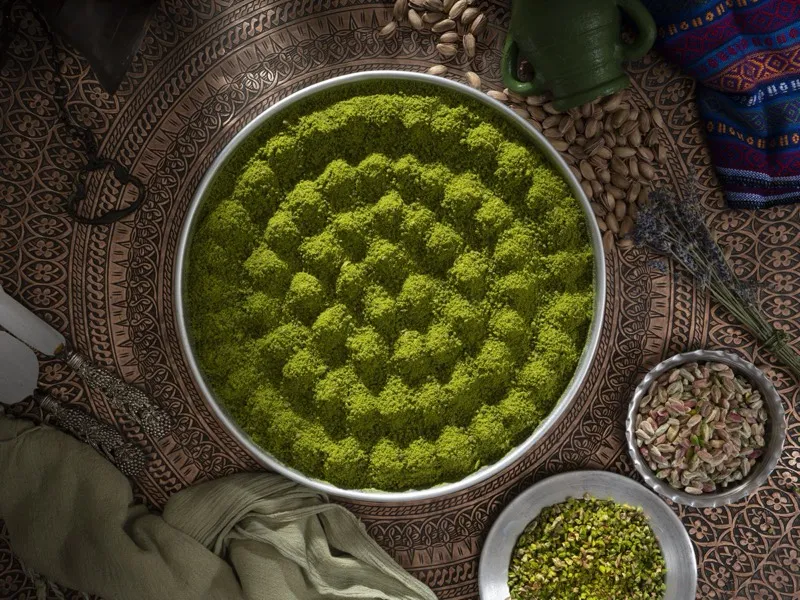
Some confections are invented. Baklava was perfected — slowly, over centuries, across cultures, by generations of hands that understood something fundamental: the simplest ingredients, handled with extraordinary care, create the most extraordinary results.
Thin layers of pastry. Butter. Nuts. Syrup. That's it. Four elements. And yet baklava, at its best, is one of the most complex, satisfying, and beautiful confections ever created. It's geometry and alchemy. Patience and passion. A dessert that has crossed empires, survived millennia, and still makes people close their eyes with the first bite.
At Sulta Rosa, baklava isn't just something we make. It's something we revere.
A History Written in Layers
The origins of baklava are ancient, and — like most things this beloved — hotly debated. Food historians trace its roots to the ancient Assyrians, who layered thin bread dough with chopped nuts and honey as early as the 8th century BCE. From there, the confection traveled through the Persian Empire, where it gained refinement, and into the kitchens of the Arab world, where it achieved something close to its modern form.
The key innovation — phyllo dough, rolled impossibly thin — likely emerged in the palace kitchens of the Middle East, where confectioners competed to create the most delicate, multi-layered pastry imaginable. Some historical accounts describe dough so thin you could read through it.
As baklava spread across the Mediterranean — through Greece, Lebanon, Syria, Iran, and North Africa — each region added its own signature. Some preferred walnuts; others insisted on pistachios. Honey gave way to sugar syrup in some traditions. Rose water or orange blossom water added aromatic dimensions.
What Makes Great Baklava?
The Pastry
Great baklava begins with great phyllo. Each sheet should be paper-thin — translucent, fragile, and crisp after baking. At Sulta Rosa, we work our phyllo by hand, building each piece layer by meticulous layer. Each sheet is brushed individually with clarified butter, the thickness judged by feel and experience.
The Nuts
Pistachios are the gold standard. Their flavor is rich but not heavy, their color is stunning, and their texture provides the perfect counterpoint to delicate phyllo. We source our pistachios with obsessive care — hand-selected for color, size, and flavor.
The Syrup
The syrup should sweeten and moisten without drowning. Great baklava syrup is balanced — sweet enough to satisfy, but with enough acidity (usually from lemon juice) to keep it bright. We infuse our syrups with orange blossom water or rose water, adding an aromatic dimension that elevates the entire experience.
The Cut
Baklava is traditionally cut into diamonds or small rectangles before baking. This allows syrup to penetrate evenly and ensures each piece holds together beautifully. The geometry of a well-cut tray of baklava is genuinely artistic.
Baklava in the Modern World
For centuries, baklava was a celebration food — made for holidays, weddings, and honored guests. But baklava is also having a modern moment. As American palates grow more sophisticated and global flavors become mainstream, baklava has moved from "exotic" to essential.
We see baklava not as a relic of the past but as a living art form — one that can embrace modern luxury while honoring ancient technique.
How Sulta Rosa Crafts Baklava
Our process is deliberately unhurried. We work in small batches because baklava demands attention, not automation.
- Preparation — Pistachios are ground to the ideal consistency. Phyllo is prepared and kept under damp cloth to prevent drying.
- Layering — Each sheet is laid by hand and brushed with clarified butter. Layer after layer, the baklava takes shape.
- Filling — Ground pistachios are distributed evenly between layers, calibrated for maximum flavor in every bite.
- Cutting — Sharp, clean cuts before baking ensure perfect pieces in the traditional diamond pattern.
- Baking — Slow, even heat transforms the layers from soft and pliable to golden and shatteringly crisp.
- Finishing — Cooled syrup, infused with orange blossom or rose water, is ladled carefully over the warm baklava.
- Resting — Each batch rests and settles before packaging to reach its ideal state.
How to Enjoy Baklava
- With strong coffee — An espresso or Arabic coffee alongside baklava is a pairing perfected by centuries of tradition.
- With tea — Mint tea, chai, or a simple black tea all complement baklava's sweetness beautifully.
- As a gift — A box of handcrafted baklava is one of the most universally appreciated gifts you can give.
- After dinner — Two or three pieces with tea is the most elegant dessert course imaginable.
Experience Sulta Rosa Baklava
Our baklava is handcrafted in Miami Beach and shipped nationwide. Every piece reflects centuries of tradition, made with modern precision and genuine love for the craft.
Explore our baklava collections at sultarosa.com.
Taste the Tradition
Handcrafted baklava, layered with care and centuries of heritage. Shipped nationwide.
Explore Baklava